



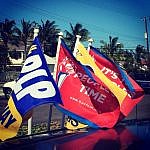



There are moments in politics when the ground shifts so suddenly that even the most seasoned observers struggle to keep their footing. The Bahamas is standing at such a moment now. With the general election no longer a distant rumour but an active, living campaign, the Free National Movement (FNM) is staring down what can only be described as a significant, self-inflicted blow—one that may prove fatal to its hopes of returning to power.
Behind the scenes, the whispers have grown into conversations, and the conversations into actions. Key figures within the FNM—men and women who once carried the party’s banner with pride—now appear more comfortable with the prospect of a second Davis administration than with an FNM led by Michael Pintard. That reality alone signals a party in deep existential trouble. When insiders would rather see their traditional rivals govern than endure their own leadership, collapse is no longer theoretical; it is imminent.
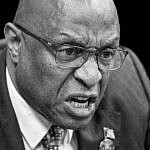
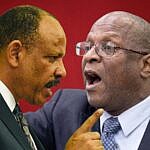
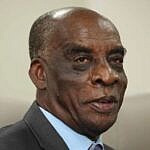
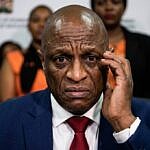
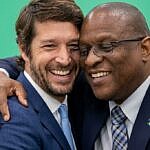
The symbolism could not be starker. Former Deputy Prime Minister and Minister of Works Desmond Bannister, long regarded as steady, respected, and battle-tested, walking openly into a PLP constituency meeting in Carmichael and locking hands with party faithful, is not a routine crossover. It is a political earthquake. His public salute to the work of the area MP and pledge of support to the PLP incumbent was not just an endorsement—it was a verdict.
This is what systemic failure looks like.
Two recent by-election defeats—West Grand Bahama and Bimini and Golden Isles—were warning shots. Instead of catalyzing renewal, they exposed a leadership vacuum. Now, reports of ratified FNM candidates reconsidering whether to even stay in the race underscore the depth of the malaise. A party that cannot inspire its own nominees cannot credibly inspire a nation.
While the opposition fractures, the governing party is doing the opposite. The Davis administration is moving with the discipline and confidence of a machine that believes momentum is firmly on its side. Constituency battles within the PLP are fierce—not because people want out, but because they want in. That contrast alone tells a powerful story.
Prime Minister Davis is not waiting for the calendar to define the campaign. The election bell is already ringing. From coordinated constituency activity to high-visibility governance initiatives—such as crown land distributions, long-awaited promotions, salary adjustments, and institutional housekeeping across key sectors—the government is clearly blending policy delivery with political readiness, which is not accidental. It is a strategy.
And make no mistake: strategy wins elections.
What we are witnessing is not the prelude to a campaign; it is the campaign itself. Two tracks are now running side by side—one of a governing party consolidating power and sharpening its message, the other of an opposition party imploding under the weight of indecision, internal dissent, and uninspired leadership.
The FNM’s most significant threat today is not the PLP. It is itself. In politics, unity is oxygen. Without it, even the strongest brand suffocates. By all indications, the FNM has chosen to throw out the baby with the bathwater—and the country is watching.
So let us be clear: the election is not “coming.” It is here. The lines are being drawn, the alliances are being declared, and the ground war is already underway.
This election is a two-straight campaign. And the seismic shift has begun.
More from LOCAL
Garden Hills asking, “Is Rick Fox Unstable & Broke?” Something is not right.
The Fox in the Garden: A Question of Intent or Necessity? The political landscape of The Bahamas is no stranger to …
NO MORE TURNING BACK! LET US MOVE FORWARD TOWARD PROGRESS!!!!
The Case for Continuity: Why The Bahamas Must Break the Cycle of "Stop, Review, and Cancel" Progress is rarely a sprint; …
How the GBPA’s “Sign Ban” Handed Pintard an Unfair Advantage
For decades, the rhythm of Bahamian democracy has been visual. From the moment an election is called, our streets transform …