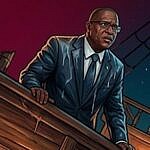






There is a specific, haunting silence that precedes the final plunge of a sinking ship. It is not the absence of noise, but the terrifying realization that the noise no longer matters. The pumps have failed, the engines are cold, and the dark Atlantic of political irrelevance is rising to meet the deck. For the Free National Movement (FNM), this is not a drill. It is the end of an era, a slow-motion tragedy written in the ink of ego and the blood of self-inflicted wounds. To understand how we arrived at this funeral pyre, one must look into the mind of the man at the helm, Michael Pintard. It is a place where naivety masquerades as confidence and manipulation is mistaken for leadership. There is a profound, almost Shakespearean irony in his tenure: a man who craves the spotlight so desperately that he has blinded himself to the fact that the theatre is burning down around him.
The Fortress of Solitude
The demise of the FNM was not a sudden explosion; it was a rot from within, fueled by a high level of insecurity. Pintard’s leadership has been defined by a crippling lack of trust in those around him. This paranoia has shrunk his circle to a microscopic size, leaving him insulated from the “wise counsel” that once made the party a titan. In politics, a leader who does not share his strategy is not a “mastermind”—he is a man wandering in a maze of his own making. By refusing to engage with the party’s veterans and intellectuals, he has essentially been flying blind.
While the late Cecil Wallace-Whitfield offered the fire of promise and Hubert Ingraham brought the cold, surgical discipline required to topple the “Infallible” Lynden Pindling, Pintard has brought only fragmentation. He has “ripped apart” every fibre of the party’s DNA. Those who “lifted” during the glory years can no longer recognize the house they built. When Dame Janet Bostwick spoke of an “uphill battle,” she was being the ultimate stateswoman. In the quiet corridors of Bahamian history, her words were a soft-spoken eulogy for a party that she knows, deep down, is already gone.
The Grand Bahama Betrayal
The most damning evidence of this political suicide lies in the abandonment of the People of Freeport. In a move that defies both logic and compassion, the leadership has prioritized the interests of the Grand Bahama Port Authority (GBPA) over the very citizens who are the lifeblood of the island. The GBPA Alliance: Choosing the corporate entity over the struggling masses was the first nail in the coffin.
The Power Company Objection
Perhaps the most egregious misstep was the objection to the government’s attempt to rescue Freeport from the “bondage” of the Grand Bahama Power Company. To stand in the way of relief for a people whose lifeblood has been sucked dry by astronomical utility costs is more than a policy error; it is a moral failure. It signals a party that has lost its soul, preferring the “status quo” of elites over the survival of the working class.
The Common Denominator
Numbers do not lie. A party that began the term with seven members in Parliament has dwindled to four. We do not need to “whistle and point” to find the culprit. When three members of your own front line decide that the wilderness is safer than your camp, the common denominator is the man holding the map. Pintard’s insistence on being “on stage”—the constant performance, the inability to distinguish between acting and governing—has left the FNM without a rudder or a sail. For four years, the ship has drifted. Now, the hull has cracked.
The Titanic Moment
Imagine, for a moment, the mental devastation of this realization. It is unexplainable to those who have never carried the weight of a legacy. To see the end of the road and realize there is no U-turn, no hidden path, and no more time. The scene is eerily reminiscent of the Titanic.
The water is chest-high. The screams of the passengers, the loyalists, the grassroots supporters, the families who believed in the torch, are drowned out by the cold spray. And there, in the background, stand the ghosts and the elders: Hubert Ingraham, Tommy Turnquest, Brent Symonette, Dionisio D’Aguilar, Maurice Moore, David Thompson and C.A. Smith. They are not shouting for help anymore. They are singing. Their voices are sobering, heavy with the weight of what has been lost. In a haunting, emotional harmony, they sing “Nearer, My God, to Thee” as the final lights of the FNM flicker and go out.
The tragedy is not just that the ship is sinking; it’s that it didn’t have to. It was steered into the iceberg by a hand that was too insecure to let anyone else touch the wheel. The FNM as we knew it is finished. The torch has flickered its last, extinguished by the very water it tried to ignore.
More from LOCAL
PINTARD SAID “HAVE PLENTY BABIES, FNM WILL PAY FOR IT!”
The Theatre of the Absurd: Pintard’s Incoherent Gambit Political leadership is often defined by the strength of one’s vision, but in …

The Shadow Over St. Anne’s: When Silence Becomes a Confession
The political atmosphere in St. Anne’s is no longer just electric; it is trembling. What was once a standard contest …
Jay Philippe Driving A Wedge in the Heart of the Over-the-Hill
In the winding, historic streets of Bain and Grants Town, where the smell of native cooking drifts over limestone walls, …