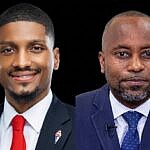






The Free National Movement has many problems, but one sits at the centre of them all: Michael Pintard.
After another national rejection, the FNM can no longer pretend that its problem is messaging, timing, money, or machinery. Those things matter in politics, but leadership sits above all of them. A party can recover from bad strategy. A party can recover from poor campaign planning. A party can recover from division. What it cannot easily recover from is a leader the public has already decided against.
That is the political burden Michael Pintard now carries.
The Bahamian people have listened to him. They have watched him. They have measured him. They have seen him in Parliament, on the campaign trail, in press conferences, and in moments when serious leadership was required. Their answer has been clear. They have declined to follow him.
That is the hard truth the FNM must now face.
Pintard has struggled to connect with ordinary Bahamians because he often sounds like a man speaking at people rather than with them. His politics feels rehearsed, distant, and overly calculated. He talks about the people, but he has failed to make the people feel that he truly knows their daily lives, their pressures, their fears, and their hopes.
Politics is about trust. It is about whether people can look at a leader and say, “That person understands me.” With Pintard, too many Bahamians see performance without connection. They see volume without warmth. They see criticism without comfort. They see ambition without a clear reason to believe.
This is why the FNM has a Pintard problem.
The party may want to blame the PLP. It may want to blame the timing of the election. It may want to blame the media, the voters, or the national mood. But none of that changes the result. The public looked at the choice placed before them and decided that Michael Pintard was unready to lead the country.
That judgment cannot be brushed aside.
The FNM must ask itself a serious question: if Michael Pintard could not persuade the country after years in opposition, after repeated opportunities to define himself, and after a campaign built around removing the government, what evidence is there that the public will suddenly see him differently?
There comes a point when a party must stop protecting a leader from political reality.
Pintard’s weakness is deeper than one election cycle. It is about temperament, image, connection, and credibility. He has never found a language that reaches beyond the FNM base. He has never fully settled the question of who he is as a national leader. He has never made Bahamians feel that he carries the emotional weight of the country.
That is why he remains limited.
The Bahamian people may disagree with the government on issues. They may complain about the cost of living, crime, bureaucracy, and the pressure of daily life. But disagreement with the government does automatically become support for the opposition. The FNM assumed public frustration would be enough. It was wrong.
People may want better. That does mean they want Pintard.
This is the central failure of his leadership. He has been unable to turn public concern into public confidence. He has been unable to turn criticism of the government into belief in himself. He has been unable to make the FNM feel like a government-in-waiting.
That is a personal political failure.
The FNM must now decide whether it wants to keep managing Pintard’s image or begin rebuilding the party. It cannot do both. A party serious about renewal must be honest about why the public pulled away. It must listen to what the country has already said.
Bahamians have made their judgment.
They do not see Michael Pintard as the answer.
And until the FNM accepts that, it will continue to confuse movement with progress, noise with leadership, and opposition with readiness.
The FNM has a Michael Pintard problem.
The longer it denies it, the longer it will remain exactly where the Bahamian people have placed it: in opposition.
More from LOCAL
AGAINST ALL ODDS: SENATOR KENO WONG HITS A HOME RUN ON THE INTERNATIONAL STAGE
Life has a way of throwing curveballs. Some people face one strike, others two, and some find themselves standing at …
FNM CONCLAVE: REVIVAL OR POLITICAL FRATERNIZATION?
THE FNM IS IN QUICKSAND, the more they wiggle, the deeper they sink. The Free National Movement (FNM) is in such …
FREEPORT’S FUTURE AT RISK: IS THERE A HIDDEN AGENDA TO STRIP THE GBPA OF ITS ASSETS?
By Bahamas Herald | Opinion FREEPORT, GRAND BAHAMA — Something appears to be stirring behind the walls of the Grand Bahama …