


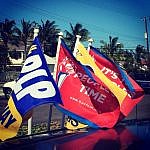



The scenes that unfolded during the advanced poll were, in many ways, a study in contrasts. On one hand, there were undeniable frustrations: long lines snaking through polling stations, delays that tested patience, and the troubling sight of seniors and persons with disabilities not receiving the care and priority they deserved. These are not minor administrative oversights—they speak to deeper issues in execution and fairness. Even more concerning was the uneven application of order. Some individuals appeared able to navigate or even bypass the system with ease, while others were left to endure the full weight of inefficiency. The presence of law enforcement, rather than restoring balance, sometimes seemed to amplify tensions, raising legitimate questions about consistency and judgment.
Yet, despite these imperfections—despite the disorganisation, the delays, and the disparities—there was one undeniable reality that no observer could ignore: a sea of blue.
It was not subtle. It was not marginal. It was dominant.
Across polling stations, the sheer volume of visible support for the Progressive Liberal Party eclipsed all else. Those dressed in plain clothes, those aligned with other political organizations, were simply dwarfed by the tidal wave of blue. It was not just about numbers—it was about energy, enthusiasm, and conviction. The kind of presence that cannot be manufactured or spun; it must be lived and felt in real time.
And if political momentum can be measured by public engagement, then the writing may already be on the wall for May 12.
Because what we are witnessing is not just routine participation—it is affirmation.
Affirmation from Bahamians who believe their lives have tangibly improved. Affirmation from citizens who can point to policies and programs that have not only been promised but delivered. In kitchens, in paychecks, in opportunities, there is a growing sense that progress is not theoretical, but practical.
This is why the argument resonates so clearly: do not tamper with an engine that is running smoothly. “Leave well enough alone.”
Of course, no administration is without fault. There are gaps. There are areas that require refinement, expansion, and deeper impact. But elections are rarely about perfection; they are about direction. And the direction, for many Bahamians, feels markedly better than where we once were.
It is impossible to ignore the emotional undercurrent as well. There remains a lingering memory of hardship under the previous administration, of policies that felt restrictive, of an atmosphere that many described as suffocating. The contrast today is stark. Where there was once tension, there is now, for many, relief. A sense of breathing room. A sense that the weight has been lifted, even if not entirely removed.
Economically, the signals reinforce this perception. International observers and regulatory bodies have acknowledged improvements. Stability is returning. Confidence is rebuilding. These are not abstract endorsements; they translate into real-world implications for investment, employment, and national morale.
So while critics may amplify the noise—the complaints, the imperfections, the logistical missteps—the broader picture tells a different story. It tells of a country that, while still on its journey, has made measurable strides forward.
And as the nation looks toward May 12, the choice may ultimately come down to a simple question: risk regression, or continue progress?
For many standing in those long lines—waiting, watching, and wearing blue—the answer already seems clear.
More from LOCAL

AGAINST ALL ODDS: SENATOR KENO WONG HITS A HOME RUN ON THE INTERNATIONAL STAGE
Life has a way of throwing curveballs. Some people face one strike, others two, and some find themselves standing at …

FNM CONCLAVE: REVIVAL OR POLITICAL FRATERNIZATION?
THE FNM IS IN QUICKSAND, the more they wiggle, the deeper they sink. The Free National Movement (FNM) is in such …

FREEPORT’S FUTURE AT RISK: IS THERE A HIDDEN AGENDA TO STRIP THE GBPA OF ITS ASSETS?
By Bahamas Herald | Opinion FREEPORT, GRAND BAHAMA — Something appears to be stirring behind the walls of the Grand Bahama …