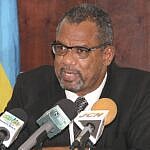








Prime Minister Philip “Brave” Davis delivered a message at the United Nations that should resonate far beyond The Bahamas: small nations cannot afford to live in a world where might makes right.
His passionate defence of sovereignty speaks directly to countries whose independence may be legally recognised but whose economic vulnerability, security concerns and limited international influence can leave them exposed to pressure from far more powerful states.
The Bahamas did not achieve independence simply to exchange one form of domination for another. Neither did the nations of the Caribbean, Africa, the Pacific or the developing world.
As Davis declared, “a sovereignty that must ask permission is not sovereignty.” That principle must mean something.
The United Nations was created around the idea that nations, regardless of population, wealth or military strength, possess sovereign equality. Yet the international system also gives extraordinary authority to the five permanent members of the Security Council, each possessing veto power.
That power carries an enormous responsibility.
It should never become a licence for powerful countries to disregard international rules when those rules become inconvenient, while expecting smaller nations to obey them without question. Rules without consistency cease to provide protection. They become instruments of power.
Small countries therefore have every reason to defend multilateralism, international law and institutions where their voices can be heard.
The Bahamas may have a population measured in hundreds of thousands rather than hundreds of millions, but our sovereignty is not worth less because our population is smaller.
Davis’s warning should therefore become a rallying call for small nations everywhere: cooperate, speak collectively and insist that international law protect the weak as firmly as it restrains the powerful.
We seek no privilege over larger nations.
We demand something far more fundamental: respect.
Because a world where powerful countries can exploit, intimidate or disregard smaller ones without consequence is not an international order worthy of defending. It is precisely the kind of world the United Nations was created to prevent.
His passionate defence of sovereignty speaks directly to countries whose independence may be legally recognised but whose economic vulnerability, security concerns and limited international influence can leave them exposed to pressure from far more powerful states.
The Bahamas did not achieve independence simply to exchange one form of domination for another. Neither did the nations of the Caribbean, Africa, the Pacific or the developing world.
As Davis declared, “a sovereignty that must ask permission is not sovereignty.” That principle must mean something.
The United Nations was created around the idea that nations, regardless of population, wealth or military strength, possess sovereign equality. Yet the international system also gives extraordinary authority to the five permanent members of the Security Council, each possessing veto power.
That power carries an enormous responsibility.
It should never become a licence for powerful countries to disregard international rules when those rules become inconvenient, while expecting smaller nations to obey them without question. Rules without consistency cease to provide protection. They become instruments of power.
Small countries therefore have every reason to defend multilateralism, international law and institutions where their voices can be heard.
The Bahamas may have a population measured in hundreds of thousands rather than hundreds of millions, but our sovereignty is not worth less because our population is smaller.
Davis’s warning should therefore become a rallying call for small nations everywhere: cooperate, speak collectively and insist that international law protect the weak as firmly as it restrains the powerful.
We seek no privilege over larger nations.
We demand something far more fundamental: respect.
Because a world where powerful countries can exploit, intimidate or disregard smaller ones without consequence is not an international order worthy of defending. It is precisely the kind of world the United Nations was created to prevent.
More from LOCAL

VJ Edgecombe’s Patriotism Deserves Praise, Not Criticism
An Opinion by a Proud Bahamian There is something deeply inspiring about a young Bahamian athlete who understands that representing his …
ACP CHASWELL HANNA & FNM MARVIN DAMES VISA REVOKED?
Dr Chaswell A. Hanna Assistant Commissioner of Police School-Based Policing & Training and Former Minister of National Security Marvin Dames …
An RPG Under A Stove — Police Baffled as Illegal Firearms Crackdown Takes Shocking Turn
Police in their quest to crack down on the proliferation of illegal firearms are baffled tonight. In what is perhaps the …